
In 2026, YouTube automation is no longer just a buzzword floating around online forums and “make money online” videos. It has become a serious content business model. Faceless channels are publishing videos at scale, building audiences across multiple niches, and in some cases crossing $10,000 per month through ad revenue, affiliate income, sponsorships, digital products, and lead generation. But the game has changed. YouTube is rewarding original, authentic content and has clarified that repetitive or mass-produced “inauthentic content” is not eligible for monetization, while reused-content reviews still focus on whether viewers can see meaningful value added by the creator. Shorts can also be monetized, but they follow their own revenue-sharing rules and must still comply with monetization policies.
That means faceless channels can still make real money in 2026, but not by uploading lazy compilations, generic AI slop, or copied footage with no human value added. The channels winning right now are more strategic. They choose better niches, package content better, write stronger hooks, add real structure and commentary, and build systems instead of relying on luck. If you want an AdSense-friendly, high-readability, SEO-smart blog topic that matches today’s creator economy, this is it. Let’s break down how faceless channels are actually reaching $10K per month in 2026, and what separates profitable automation from channels that never get monetized.
Why YouTube Automation Still Works in 2026
A lot of people assume YouTube automation is “dead” every time YouTube updates a policy or the market gets crowded. In reality, the model still works because the core logic still works: YouTube rewards content that keeps viewers watching, satisfies search intent, and offers original value. The platform did not ban faceless channels. What it tightened is monetization around low-effort, repetitive, or unoriginal uploads. That is a very different thing.
This is why the best faceless channels are not trying to trick the system. They are building real media assets. They publish documentary-style explainers, educational breakdowns, finance summaries, celebrity business analysis, tech updates, sports stories, list-based storytelling, and niche tutorials. Many viewers do not care whether a face is on screen. They care whether the title is compelling, the topic is relevant, the pacing is strong, and the video gives them something useful, entertaining, or surprising.
That is the big shift in 2026. Faceless channels are no longer winning because they are faceless. They are winning because they are efficient. They use systems, scripting workflows, design templates, voice pipelines, and research frameworks to produce content faster than traditional solo creators, while still staying within YouTube’s expectations for authentic content.

What “Faceless” Actually Means Now
In 2026, a faceless channel does not mean a lazy channel. It means the creator does not appear on camera. That is all. The voice can still be original. The storytelling can still be original. The editing can still be original. The analysis can still be original. The value can still be very high.
This distinction matters because monetization decisions increasingly come down to whether your videos feel genuinely made by you, even if you are not visually present. YouTube has been explicit that there is no new reused-content rule, but channels still need to show clear originality and a meaningful difference from source material. In 2025, YouTube also clarified its old “repetitious content” guidance under the label “inauthentic content,” emphasizing that mass-produced repetitive uploads remain ineligible for monetization.
So what does a strong faceless channel look like in practice?
It usually includes:
- original scripts or original narrative structure
- a clear editing style
- voiceover with human tone or highly customized delivery
- smart visual sequencing, not random stock footage
- commentary, comparison, explanation, or storytelling
- titles and thumbnails designed around viewer curiosity
That is why some faceless channels sail through monetization while others get rejected. One feels like a real channel. The other feels like automated filler.
The Business Model Behind $10K/Month
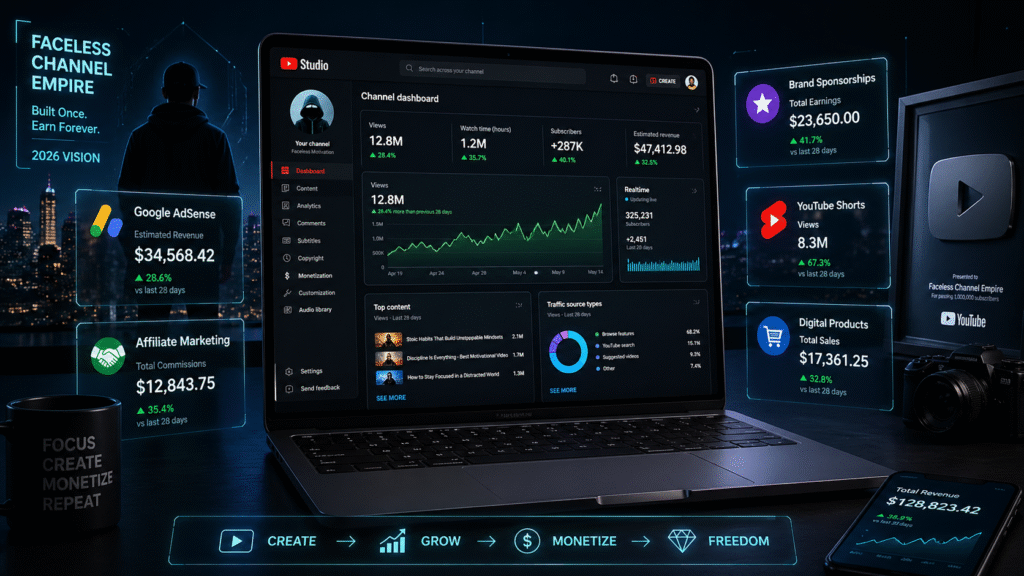
The dream of making $10K per month from a faceless channel sounds exciting, but it usually does not come from one income stream alone. The strongest channels build layered monetization.
The first layer is AdSense. This is still the foundation for many long-form channels, especially in higher-CPM niches like finance, software, business, productivity, insurance, marketing, and career education. The second layer is affiliate income. A faceless channel reviewing tools, breaking down business apps, discussing AI workflows, or teaching software can make meaningful commissions from affiliate offers. The third layer is sponsorships. Brands are happy to work with faceless channels when the audience quality is strong and the view count is consistent. The fourth layer is owned monetization, such as ebooks, templates, mini-courses, newsletters, consulting, or digital communities.
This matters because the path to $10K gets more realistic when you stop imagining it as “just ads.” A channel earning $4,000 from ads, $3,000 from affiliates, $2,000 from sponsors, and $1,500 from digital products is much more believable than a brand-new creator expecting viral ad revenue alone.
Shorts can also contribute, but creators need to understand that Shorts revenue sharing is separate from long-form revenue and is tied to the Shorts feed system, eligible views, and acceptance of the Shorts monetization module. Shorts can be valuable for growth, brand awareness, and funneling traffic, but many faceless channels still rely on long-form content as the profit engine.
The Best Faceless Niches for 2026
Not all faceless niches are equal. Some are easy to start but hard to monetize. Others are highly profitable but require more research and credibility. In 2026, the strongest faceless niches usually sit at the intersection of audience demand, long-term relevance, and monetization potential.
Technology and AI remain strong because people are actively searching for tools, comparisons, updates, and productivity use cases. Business and entrepreneurship channels work well because viewers are often high-intent and attractive to advertisers. Personal finance, investing basics, side hustle breakdowns, and digital income channels continue to pull strong attention, though they require care around compliance and credibility. Software tutorials, career advice, B2B explainers, productivity systems, and educational storytelling also remain excellent choices. Entertainment-based faceless niches like celebrity breakdowns, sports stories, and documentary-style channels can perform very well, but they need better packaging and stronger originality to stay monetization-safe.
The weak niches in 2026 are usually those built on copied clips, recycled Reddit posts with generic voiceover, endless top-10 lists with no real insight, or “news” channels that simply reword other reports without meaningful commentary. Those can get views, but they also carry higher monetization risk because they can easily drift into reused or inauthentic territory.
The best niche is not the one with the most views. It is the one where you can create original value repeatedly.
What Winning Faceless Channels Are Doing Differently
The channels crossing real income milestones in 2026 are not just uploading more. They are making smarter creative decisions.
First, they obsess over packaging. A faceless video with a weak title dies fast. A faceless video with a bland thumbnail rarely gets a chance. Since the creator is not using face-based charisma, the packaging has to do even more work. The best channels use titles that create curiosity, urgency, surprise, or a clear payoff. Their thumbnails are simple, emotional, and instantly readable.
Second, they build strong openings. The first 20 to 30 seconds are critical. High-performing faceless videos often start with a sharp promise, a surprising fact, a strong tension point, or a question the viewer wants answered.
Third, they write for retention. Instead of fluffy intros and repeated filler, the scripting moves quickly. Every section adds something new. Every minute either deepens the story or moves the viewer toward a payoff.
Fourth, they create recognizable formatting. The channel begins to feel familiar. Viewers know what they are getting. That helps build return traffic and trust.
Fifth, they use automation to support quality, not replace thinking. Templates, AI-assisted drafts, research workflows, editing checklists, and outsourcing can absolutely speed up production. But the channels making money are still exercising editorial judgment. That is the difference between automation and noise.
How AI Fits Into YouTube Automation in 2026
AI is now embedded in the creator workflow, but it is not a magic ATM. It is a multiplier.
The smart use of AI in faceless YouTube usually looks like this:
- generating topic ideas from trend clusters
- summarizing source material for research
- drafting script outlines
- helping repurpose long-form into Shorts
- accelerating thumbnail testing ideas
- cleaning audio or speeding up rough cuts
- translating content for multi-language channels
The wrong use of AI is to let it produce flat, generic, repetitive videos with no editorial taste. That is exactly the kind of content likely to feel mass-produced and weak. And weak content is a monetization problem even before it is a policy problem.
AI can help you move faster, but it cannot replace perspective. In fact, as more creators use AI, originality matters more, not less. Viewers are already getting better at detecting robotic scripting, unnatural voice pacing, and lifeless video structure. The channels that win are the ones that use AI behind the scenes while keeping the final product sharp, human, and intentionally crafted.
What AdSense-Friendly Faceless Content Looks Like
For a channel to become a stable income asset, it is not enough to get views. It needs to be advertiser-friendly and monetization-safe. YouTube’s advertiser-friendly guidelines continue to shape what can earn fully, partially, or not at all, and those guidelines do change over time. In early 2026, YouTube published updates to areas like shocking content and controversial issues, which shows that creators need to keep a close eye on ad suitability if they are building a media business.
For most faceless channels, AdSense-friendly content usually has these traits:
- clear educational, informational, or entertainment value
- no graphic or sensationalized harmful content
- no misleading claims or spammy packaging
- no excessive profanity, especially in risky placement or context
- no heavy dependence on copyrighted material
- no fake engagement or artificial traffic
This is one reason why evergreen content can outperform drama-heavy content over time. A channel built around software tutorials, business lessons, AI workflows, self-improvement, history explainers, or niche education is often easier to monetize consistently than one built entirely on controversy and shock. AdSense stability matters because a channel that keeps getting yellow icons, limited ads, or reused-content warnings becomes much harder to scale to $10K per month.
The Real Growth Strategy: Search, Suggested, and Shorts Together
One mistake new creators make is betting everything on one traffic source. The strongest faceless channels in 2026 usually combine search, suggested video traffic, and Shorts strategically.
Search content works well for tutorials, comparisons, educational topics, and “how-to” style videos. This traffic can be stable and evergreen. Suggested traffic is where scale happens, especially for storytelling, niche commentary, documentary formats, and highly clickable informational content. Shorts help creators reach new viewers faster and build channel awareness, even if Shorts alone are not the main money-maker.
That creates a three-part system:
- searchable videos bring steady traffic
- suggested-friendly videos create breakout potential
- Shorts accelerate audience discovery
This hybrid model is especially strong for faceless brands because it reduces reliance on a single format. It also lets creators test ideas quickly in Shorts before expanding winning themes into long-form content.
Why Most Faceless Channels Never Reach $10K
The truth is that most channels fail for boring reasons, not mysterious ones.
They pick weak niches.
They publish copied formats.
They rely on generic AI scripts.
They ignore thumbnails.
They upload inconsistently.
They chase volume instead of quality.
They do not study retention.
They quit too early.
A faceless channel is still a content business. It needs positioning, quality control, audience understanding, and patience. Many people enter YouTube automation expecting passive income from the beginning. In reality, the early phase is very active. You are testing formats, learning what your viewers respond to, fixing scripting problems, improving pacing, and understanding why one upload performs while another dies.
Another major reason channels fail is that they build around loopholes instead of value. That is risky in any platform business. The channels with staying power are the ones that could still make sense even if YouTube tightened one more policy tomorrow. They are built on audience usefulness, not shortcuts.
A Realistic Roadmap to $10K/Month
A realistic path in 2026 is not “start today, make $10K in 30 days.” A more believable roadmap looks like this:
In the first stage, you identify a niche with both demand and monetization potential. You publish enough videos to see early data and learn what hooks work. In the second stage, you lock onto a repeatable format. Your scripting improves, click-through rate improves, and audience retention gets stronger. In the third stage, a few videos begin pulling meaningful search or suggested traffic. You refine the channel around what is actually working, not what you originally guessed would work.
By the fourth stage, monetization expands. AdSense starts paying regularly. Affiliate offers fit naturally into your content. Sponsorship conversations become possible once your channel has consistency. Then, over time, you add an owned product or lead magnet. This is the stage where the channel starts behaving like a real business rather than an experiment.
That is how faceless channels reach $10K per month. Not with one lucky upload, but with compounding systems.

Conclusion
YouTube automation in 2026 is still a real opportunity, but it is no longer a lazy opportunity. Faceless channels are making $10K per month because they are building real content operations around originality, consistency, packaging, and multi-stream monetization. YouTube’s current stance makes the path clear: authentic, value-adding channels can thrive, while repetitive, mass-produced, or weakly transformed content remains at risk for monetization issues. Shorts are useful. AI is useful. Automation is useful. But none of them replace strategy.
The creators who win in this space understand something simple but powerful: faceless does not mean personality-free, value-free, or effort-free. It means building a media brand where the content itself does the work. If you choose the right niche, create genuinely useful or entertaining videos, stay advertiser-friendly, and build monetization beyond ads alone, a faceless channel can absolutely become a serious income asset in 2026. The opportunity is still here. The standard is just higher now.